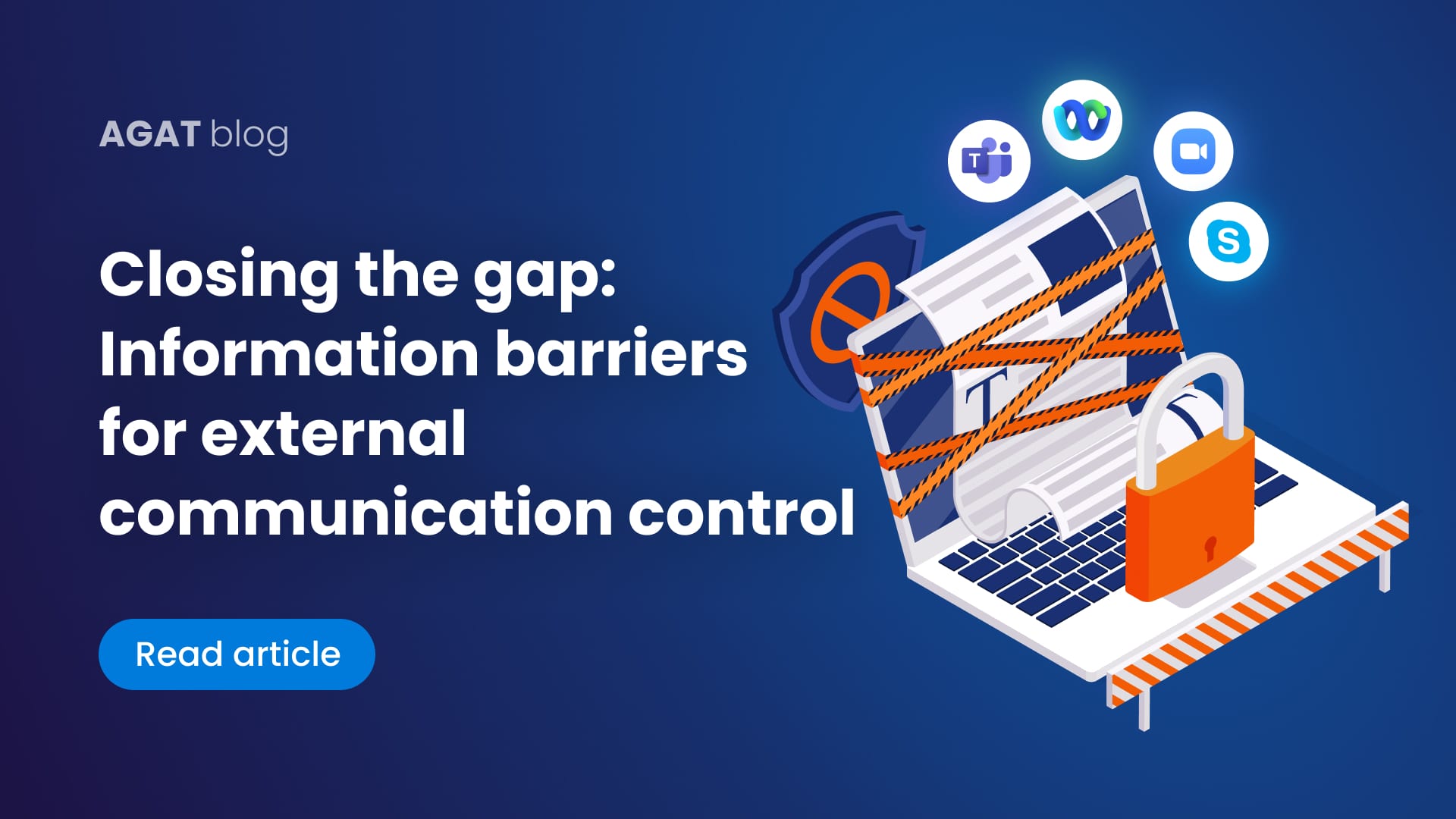
Set flexible communication policies, block interaction between restricted users with total granularity for communication types. (chat, file sharing, screen sharing etc.)
Choose your service:
Real Time DLP
Real-Time inspection of content. Block sensitive data before it reaches the cloud and destination user. Review conversation context with eDiscovery.
Choose your service:
Archive & eDiscovery
Archive your data safely in the cloud or on site and search for any communication by several parameters such as user, date, channel or text.
Choose your service:
Recording AI Compliance Analysis
Record meetings, search them and analyze them using video and audio transcript. Apply DLP policies.
Set flexible communication policies, block interaction between restricted users with total granularity for communication types. (chat, file sharing, screen sharing etc.)
Choose your service:
Ethical Wall
Set flexible communication policies, block interaction between restricted users with total granularity for communication types. (chat, file sharing, screen sharing etc.)
Choose your service:
Real Time DLP
Real-Time inspection of content. Block sensitive data before it reaches the cloud and destination user. Review conversation context with eDiscovery.
Choose your service:
Archive & eDiscovery
Archive your data safely in the cloud or on site and search for any communication by several parameters such as user, date, channel or text.
Choose your service:
Recording AI Compliance Analysis
Record meetings, search them and analyze them using video and audio transcript. Apply DLP policies.
Choose your service:
Recording AI Compliance Analysis
Record meetings, search them and analyze them using video and audio transcript. Apply DLP policies.
Choose your service:
Recording AI Compliance Analysis
Record meetings, search them and analyze them using video and audio transcript. Apply DLP policies.
Set flexible communication policies, block interaction between restricted users with total granularity for communication types. (chat, file sharing, screen sharing etc.)
Set flexible communication policies, block interaction between restricted users with total granularity for communication types. (chat, file sharing, screen sharing etc.)
AGI helps improve collaboration by detecting meeting and chat insights to automatically generate items such as tasks, meeting notes, summaries, and minutes.
Following Microsoft’s announcement that it has launched the next version of Lync as Skype for Business, No Jitter conducted a survey to assess enterprise adoption of and attitudes toward the Microsoft Unified Communications (UC) platform and all its various components.
The survey on Lync/Skype for Business use included responses from 540 enterprise IT professionals, with more than half (52 percent) responding that they had already adopted Lync/Skype for Business.
When asked which functions they currently used Lync for, the majority of respondents named presence and instant messaging. This was followed by Web and audio conferencing as well as desktop video.
Using Lync/Skype for Web conferencing typically extends the usage of Lync outside network boundaries and requires action to be taken to secure the deployment as LyncShield does.
At the same time, Web conferencing was seen as the main function used in hosted Skype for Business service, followed by audio conferencing and presence and instant messaging.
Skype for Business will retain all Lync capabilities, including content sharing and telephony, while adding video calling and the Skype user directory, making it possible to call any Skype user on any device.
 Skip to the content